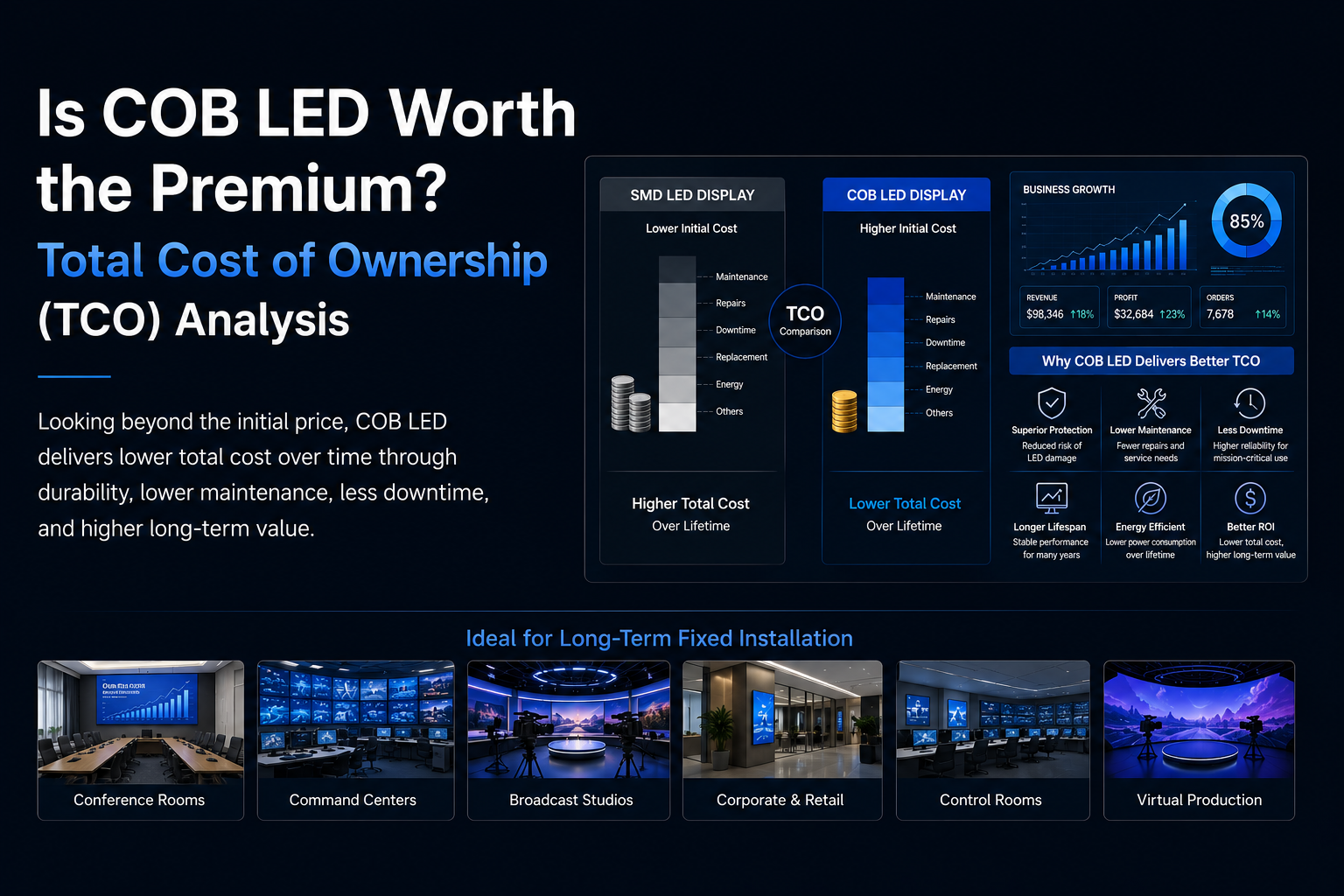
When choosing an LED display for a long-term project, the initial purchase price is only one part of the investment. While COB LED displays typically have a higher upfront cost than traditional SMD LED displays, the real question is whether the additional investment can deliver better long-term value.
This is where Total Cost of Ownership (TCO) becomes important.
Instead of looking only at the purchase price, TCO considers the complete cost of owning and operating an LED display throughout its service life—including maintenance, repairs, replacement, downtime, and energy consumption.
What Is Total Cost of Ownership?
For an LED display project, TCO can be considered as:
TCO = Initial Investment + Maintenance + Repairs + Replacement + Downtime + Operating Costs
A lower purchase price does not necessarily mean a lower total cost.
For applications such as fixed installation LED displays, conference room video walls, command centers, control rooms, broadcast studios, and commercial LED video walls, the display may operate for many years. Therefore, reliability and maintenance can have a significant impact on the overall project cost.
Why Is COB LED More Expensive Upfront?
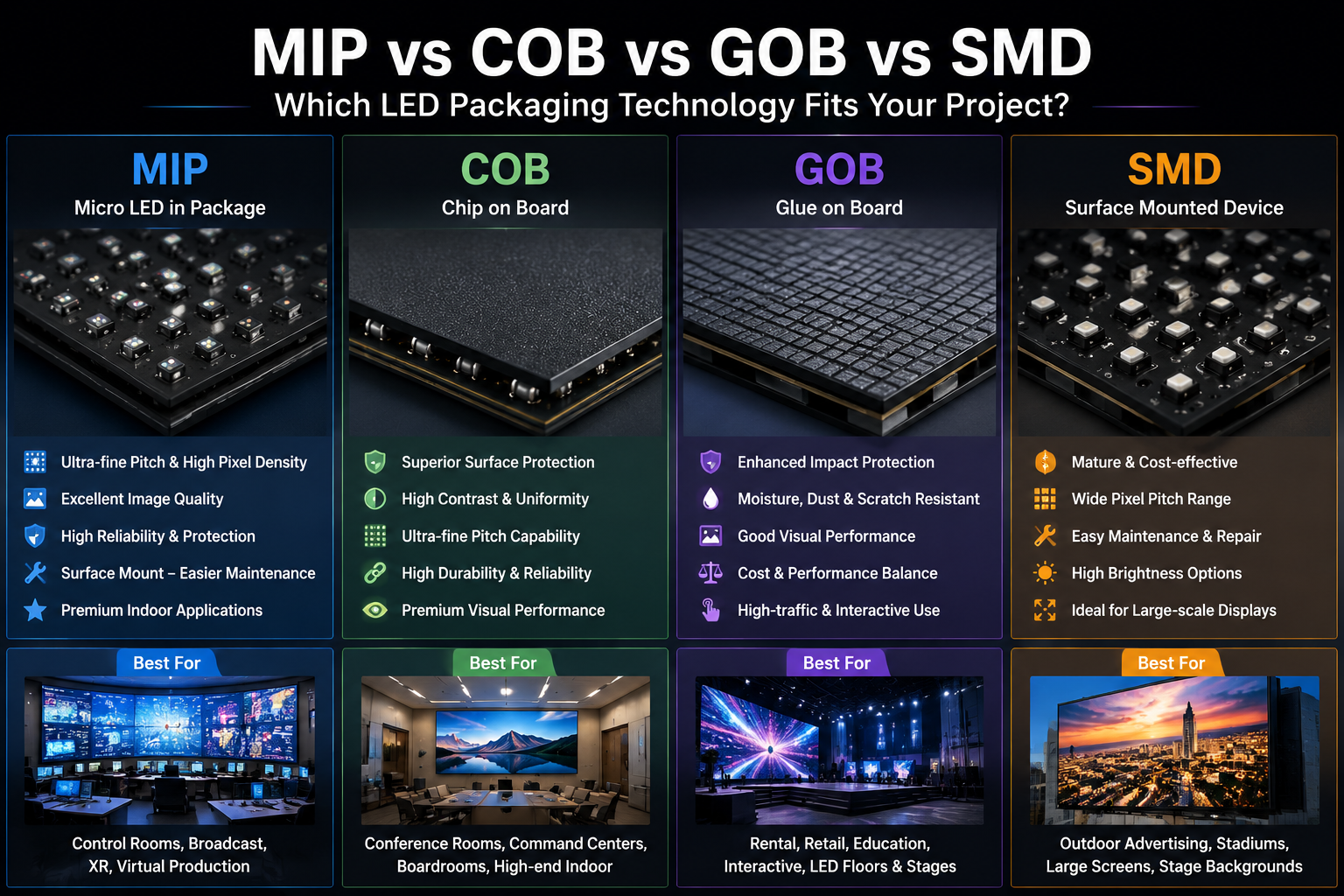
COB, or Chip-on-Board, integrates LED chips directly onto the PCB and uses a common encapsulation layer to protect the LED chips.
This manufacturing process provides several advantages, including:
- Higher LED chip integration
- Better surface protection
- Improved physical durability
- Fine pixel pitch capability
- Excellent contrast
- More uniform display surface
- Strong suitability for high-end indoor LED applications
However, the more advanced packaging process can result in a higher initial investment compared with conventional SMD LED displays.
The important question is whether these advantages reduce costs over the lifetime of the installation.
1. Lower Risk of Physical Damage
One of the biggest advantages of COB LED technology is its integrated and protected LED surface.
Traditional SMD LED displays have individual LED packages exposed on the surface. These packages can be more vulnerable to accidental impact during transportation, installation, maintenance, or everyday operation.
COB technology provides a more protected surface structure.
For fixed installation LED video walls, this can reduce the risk of damage caused by accidental contact or maintenance activities.
Less physical damage can mean:
Fewer repairs → Less downtime → Lower maintenance cost
2. Reduced Maintenance Requirements
Maintenance is one of the most important factors in TCO analysis.
For a large LED video wall, even a small number of damaged LED modules can require technicians, spare parts, transportation, and service time.
COB LED displays are designed with durability and long-term stability in mind. Their integrated packaging structure helps protect the LED chips and can reduce the frequency of physical damage.
This is especially valuable for:
- Corporate LED displays
- Conference room LED video walls
- Command center displays
- Control room LED walls
- Broadcast LED screens
- Digital signage
- Permanent indoor installations
For a long-term project, lower maintenance requirements can offset part of the initial COB premium.
3. Less Downtime Has Real Financial Value
Downtime is often overlooked when comparing LED display technologies.
Imagine a large LED video wall installed in a corporate headquarters, broadcast studio, or command center. If the display requires frequent maintenance, the cost is not limited to the replacement module.
There may also be:
- Technician labor
- Equipment and access costs
- Production interruption
- Event disruption
- Business downtime
- Content replacement or rescheduling
For mission-critical applications, display reliability can therefore be more valuable than simply choosing the lowest initial price.
A more reliable COB LED video wall can help minimize these indirect costs.
4. COB Is Well Suited to Fine-Pitch Applications
COB technology is particularly suitable for fine-pitch LED displays.
Products such as P0.7, P0.9, P1.2, and P1.5 COB LED displays are increasingly used in environments where viewers are close to the screen.
Typical applications include:
- Conference rooms
- Boardrooms
- Control rooms
- Command centers
- Broadcast studios
- Virtual production
- High-end retail
- Corporate experience centers
When pixel pitch becomes smaller, image quality, surface uniformity, and viewing experience become increasingly important.
Therefore, the TCO analysis should not only consider the purchase price but also the expected service life and performance requirements.
5. Better Long-Term Image Quality
A professional LED display is expected to maintain consistent visual performance over many years.
COB LED technology can provide a highly integrated pixel structure and uniform display surface, which can be beneficial for applications requiring high image quality.
For camera-intensive applications such as broadcast and virtual production, other specifications—including refresh rate, scan mode, grayscale performance, color calibration, and processing—must also be considered.
The best TCO is not simply the cheapest display. It is the display that continues to meet the project's performance requirements throughout its expected lifespan.
COB vs. SMD: Looking Beyond Initial Price
| TCO Factor | COB LED | SMD LED |
|---|---|---|
| Initial Cost | Higher | Lower |
| Physical Protection | Excellent | Good |
| Fine Pixel Pitch | Excellent | Good |
| Surface Uniformity | Excellent | Good |
| Maintenance Risk | Low | Medium |
| Long-Term Durability | Excellent | Good |
| Fixed Installation | Excellent | Excellent |
| Premium Applications | Excellent | Good |
| Long-Term Value | High | Depends on application |
The right choice depends on the project.
For a short-term rental or cost-sensitive application, SMD may provide a better initial investment.
For a permanent LED installation where reliability, durability, maintenance, and long service life are priorities, the additional COB investment can be easier to justify.
When Is COB LED Worth the Premium?
COB LED is particularly worth considering when:
1. The display will be used for many years
A longer service period gives the reliability and maintenance advantages more opportunity to offset the initial premium.
2. The display is difficult or expensive to access
For large fixed installation LED displays, maintenance can require significant labor and equipment.
3. The application is mission-critical
Command centers, control rooms, and broadcast environments cannot easily tolerate unexpected downtime.
4. The viewing distance is short
Fine-pitch COB LED displays can provide an excellent visual experience in conference rooms and other close-viewing environments.
5. Physical durability is important
COB's protected surface structure can be beneficial in permanent installations.
6. Image quality is a long-term priority
High-end commercial and corporate installations often require consistent visual performance rather than simply the lowest purchase price.
A Simple TCO Example
Consider two LED video wall solutions with the same screen size.
- SMD LED: Lower initial investment
- COB LED: Higher initial investment
At first glance, SMD appears to be the cheaper option.
However, over a five- to eight-year installation period, the actual cost may include maintenance visits, spare modules, technician labor, replacement components, downtime, and eventual refurbishment.
If the COB display requires fewer repairs and experiences less downtime, the difference between the two technologies may become much smaller when calculated over the entire lifecycle.
This is why project owners should evaluate cost per year of operation, rather than simply comparing the purchase price.
How to Calculate COB LED TCO
When evaluating an LED display project, consider these five categories:
Initial Investment
- LED cabinets
- LED modules
- LED controller
- Power supplies
- Installation
- Structural system
Maintenance
- Spare modules
- Technician labor
- Cleaning
- Calibration
- Preventive maintenance
Repairs
- Damaged LED components
- Receiving cards
- Power supplies
- Cables and connectors
Downtime
- Business interruption
- Event interruption
- Production delays
- Technician response time
End-of-Life Costs
- Refurbishment
- Component replacement
- Screen upgrade
- Disposal or recycling
A comprehensive TCO model provides a much more accurate picture of the real investment.
The Bottom Line
Is COB LED worth the premium?
For every project, the answer is different.
If the primary objective is the lowest possible upfront cost, SMD LED may remain attractive.
However, for fixed installation LED displays where durability, reliability, fine pixel pitch, low maintenance, and long-term performance are important, COB LED can offer stronger overall value.
The real question is not:
“Which LED display costs less?”
It is:
“Which LED display delivers the lowest total cost over its entire service life?”
For long-term projects such as COB LED video walls, conference room LED displays, command center LED walls, control room displays, broadcast LED screens, and premium indoor fixed installation LED displays, evaluating TCO can make the decision much clearer.