When choosing an LED display, pixel pitch and resolution are only part of the decision. The LED packaging technology behind the display can have a major impact on image quality, durability, maintenance, protection, and total project cost.
Today, four technologies are increasingly discussed in the fine-pitch LED display market: MIP, COB, GOB, and SMD.
But which one is right for your project?
The answer depends on where the display will be installed, how close the audience will be, how much physical protection is required, and how important serviceability and budget are.
In this guide, we compare MIP vs COB vs GOB vs SMD LED displays across key technical parameters and real-world applications.
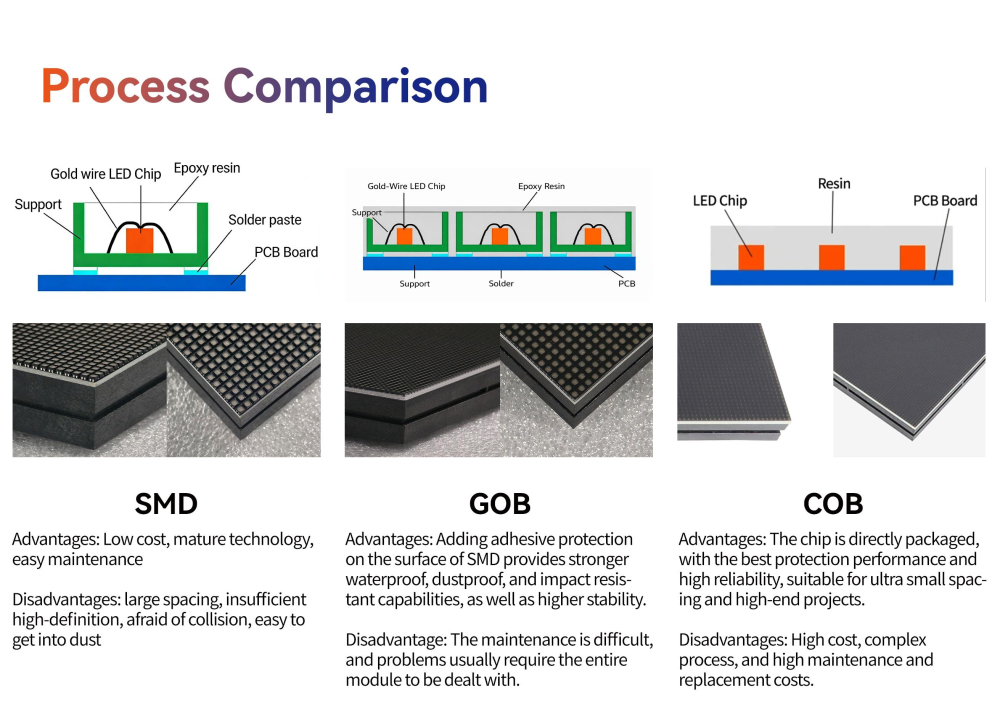
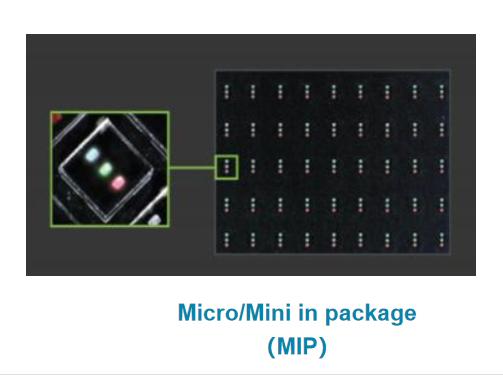
1. What Are MIP, COB, GOB, and SMD LED Technologies?
Before comparing specifications, it is important to understand how these four technologies are constructed.
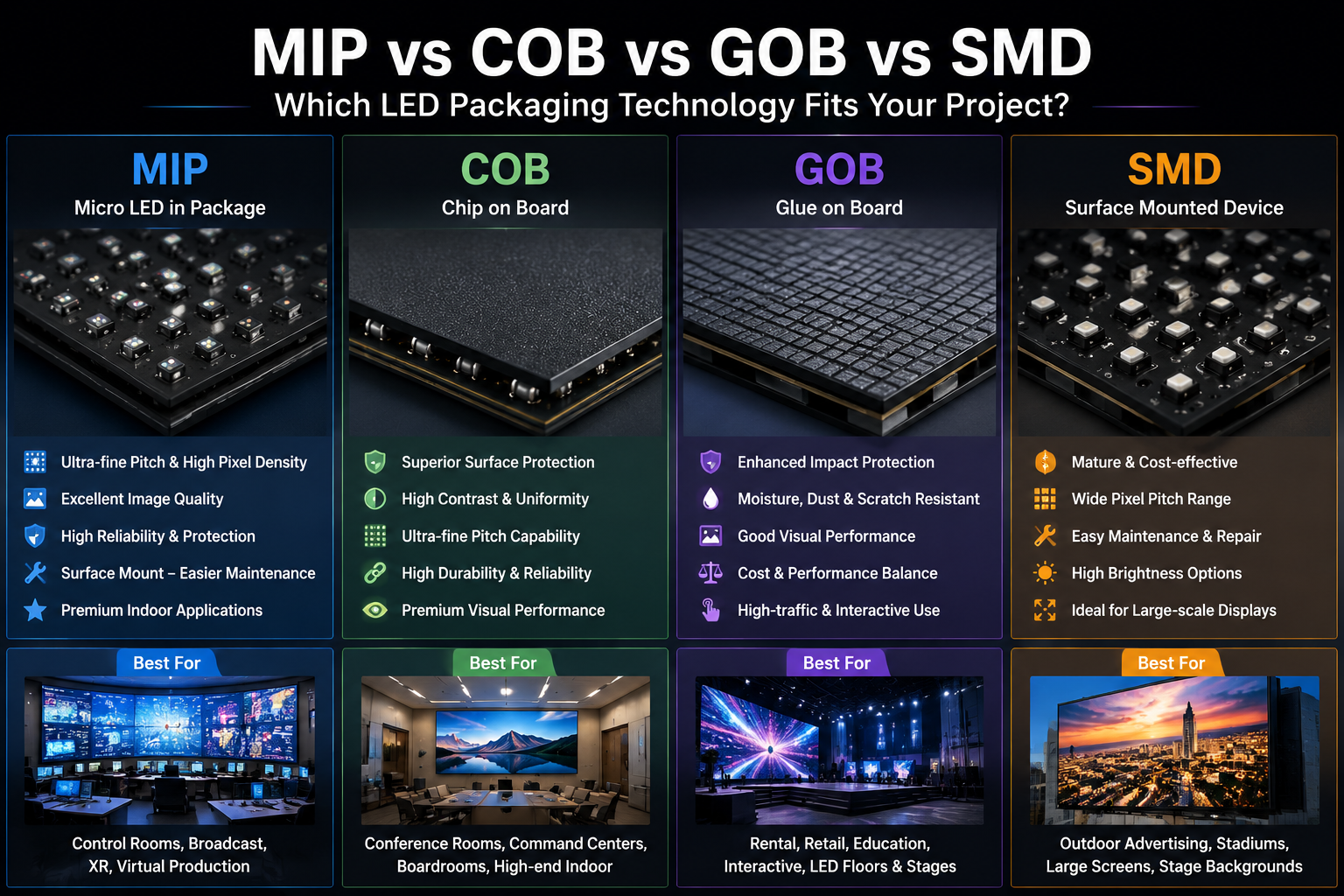
MIP: Micro LED in Package
MIP (Micro LED in Package) integrates multiple micro-LED dies into a compact package before the package is mounted onto the PCB.
Unlike traditional Micro LED manufacturing, MIP packages can simplify the placement and testing of RGB micro-LED chips. MIP is increasingly used for fine-pitch LED displays where manufacturers want to combine high pixel density, strong image quality, and relatively convenient surface mounting.
Current MIP products are commonly available in fine pitches such as P0.6, P0.7, P0.9, P1.2 and P1.5, although the actual range depends on the manufacturer and package design.
Typical applications:
- Premium indoor LED displays
- Control rooms
- Conference rooms
- Broadcast studios
- XR and virtual production
- High-end commercial displays
COB: Chip on Board
COB (Chip on Board) mounts LED chips directly onto the PCB or substrate instead of using individual SMD LED packages.
The chips are then encapsulated with a protective material, creating a relatively flat and integrated display surface.
This structure removes many of the exposed components found in conventional SMD displays and makes COB particularly attractive for fine-pitch and ultra-fine-pitch LED applications.
COB is widely used for applications where image uniformity, surface protection, contrast, and close viewing are important.
Typical applications:
- Command centers
- Control rooms
- Boardrooms
- Conference rooms
- Broadcast studios
- High-end indoor LED walls
GOB: Glue on Board
GOB (Glue on Board) is generally an enhanced version of SMD technology.
The LED packages are first mounted onto the PCB using the conventional SMD process. A transparent protective resin is then applied across the module surface.
The result is a display surface with better resistance to impact, dust, moisture, and accidental contact compared with standard exposed SMD LEDs.
Because GOB retains the underlying SMD architecture, it can offer a useful balance between protection, cost, and serviceability.
Typical applications:
- Rental LED displays
- Retail environments
- Education
- Museums
- Interactive displays
- High-traffic indoor installations
- LED floors and stage applications
SMD: Surface Mounted Device
SMD (Surface Mounted Device) is one of the most mature and widely adopted LED display packaging technologies.
In an SMD LED display, red, green, and blue LED chips are packaged into individual LED components and then soldered onto the PCB.
SMD offers a mature supply chain, wide pixel-pitch availability, relatively simple maintenance, and competitive pricing.
It remains a practical choice for many indoor and outdoor LED display projects.
Typical applications:
- Outdoor advertising
- Stadium displays
- Stage LED screens
- Rental displays
- Retail signage
- Large-format LED video walls
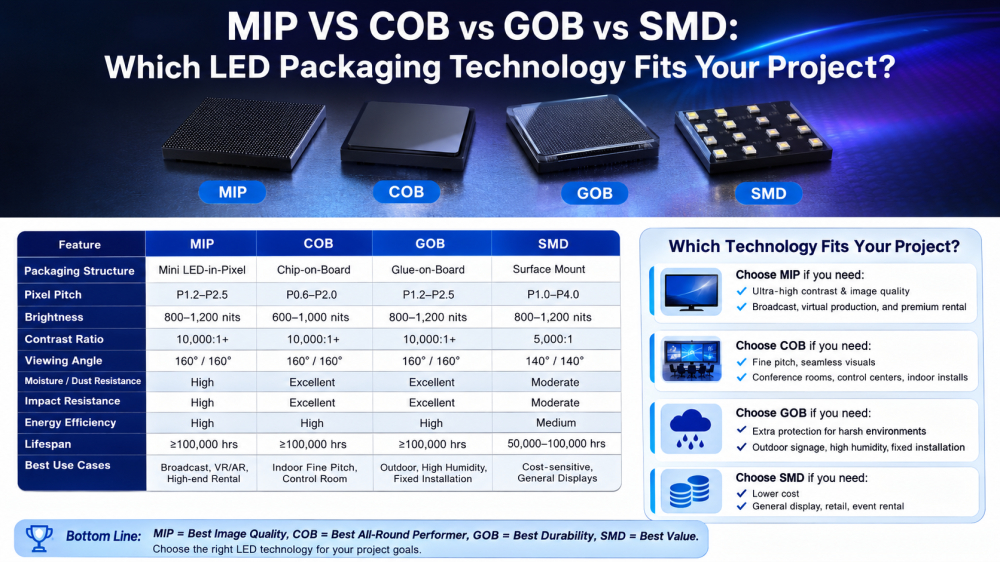
2. MIP vs COB vs GOB vs SMD: Key Parameter Comparison
The following table provides a general technology-level comparison. Actual specifications should always be confirmed against the specific LED display model and manufacturer datasheet.
| Parameter | MIP | COB | GOB | SMD |
|---|---|---|---|---|
| Packaging Structure | Micro LED in Package | Chip on Board | SMD + Protective Glue | Surface Mounted Device |
| Typical Pixel Pitch | P0.6–P1.95+* | P0.4–P2.5+* | P1.2–P4.0+* | P0.9–P10+* |
| Pixel Density | Very High | Extremely High | High | Medium–High |
| Surface Protection | High | Excellent | Excellent | Standard |
| Impact Resistance | High | Excellent | Excellent | Moderate |
| Moisture Resistance | High | Excellent | Excellent | Model dependent |
| Contrast Performance | Excellent | Excellent | Good–Very Good | Good |
| Color Uniformity | Excellent | Excellent | Good–Very Good | Good |
| Fine-Pitch Capability | Excellent | Excellent | Very Good | Good |
| Viewing Angle | Wide | Very Wide | Wide | Wide |
| Maintenance | Pixel/package serviceable | Module-level service commonly used | More difficult than SMD | Relatively easy |
| Repairability | High | Moderate | Moderate | High |
| Cost | Medium–High / High | High | Medium | Low–Medium |
| Best Application | Premium fine-pitch | Premium fine-pitch & mission-critical | High-protection applications | Cost-sensitive large displays |
*Typical ranges vary significantly by manufacturer, LED package, module design and target application.
For example, current commercial MIP products include P0.78/P0.9375 models, while other MIP product families extend from approximately P0.6 to P1.95.
3. Pixel Pitch: MIP and COB Have an Advantage for Fine-Pitch Displays
Pixel pitch is one of the most important parameters when selecting an LED display.
A smaller pixel pitch means more pixels can be placed within the same physical area, allowing the screen to produce more detailed images at close viewing distances.
For example:
- P0.6–P0.9: Premium close-viewing applications
- P1.0–P1.5: Conference rooms, control rooms and broadcast
- P1.5–P2.5: Corporate, retail and commercial applications
- P2.5+: Larger viewing distances and many outdoor applications
MIP and COB are particularly attractive for fine-pitch applications because their packaging structures allow higher pixel density than traditional large SMD packages.
MIP products have already demonstrated pitches below 1 mm, including P0.5 research and prototype displays and commercial P0.7/P0.9 products.
Fine-Pitch Comparison
| Pixel Pitch | MIP | COB | GOB | SMD |
| P0.5 | ★★★★★ | ★★★★★ | — | — |
| P0.7 | ★★★★★ | ★★★★★ | ★★ | ★★ |
| P0.9 | ★★★★★ | ★★★★★ | ★★★ | ★★★ |
| P1.2 | ★★★★★ | ★★★★★ | ★★★★ | ★★★★ |
| P1.5 | ★★★★★ | ★★★★★ | ★★★★ | ★★★★★ |
| P2.5 | ★★★★ | ★★★★ | ★★★★★ | ★★★★★ |
| P4.0+ | ★★★ | ★★★ | ★★★★★ | ★★★★★ |
Key takeaway:
If your project requires sub-1.0 mm pixel pitch, MIP and COB should be among the first technologies you evaluate.
4. Image Quality: Why Packaging Matters
Image quality is not determined by packaging technology alone. LED chips, driver ICs, calibration, optical design, PCB design and image processing all contribute to the final result.
However, packaging can influence the visual characteristics of the display.
MIP
MIP can provide:
- High pixel density
- Excellent color consistency
- High contrast
- Fine pixel pitch
- Good uniformity
Some commercial MIP products specify contrast ratios of around 15,000:1, but this should be treated as a product-specific specification rather than a universal MIP value.
COB
COB provides a relatively integrated and flat emitting surface. Its structure can reduce the visual impact of exposed SMD packages and is particularly effective for close-viewing environments.
GOB
GOB improves the surface characteristics of SMD modules by covering the LED surface with protective resin. However, the underlying optical structure remains SMD-based.
SMD
SMD provides excellent image quality when properly designed and calibrated, especially at medium and larger pixel pitches.
5. Protection and Durability Comparison
If your LED display is installed in a location where people can touch, clean or accidentally hit the screen, protection becomes a major consideration.
SMD
Standard SMD LEDs remain relatively exposed compared with COB and GOB.
This is usually not a problem when the display is installed out of reach, but it can increase the risk of physical damage in high-contact environments.
GOB
GOB adds a transparent protective layer over the SMD module.
This provides additional resistance to:
- Physical impact
- Dust
- Moisture
- Scratches
- Accidental contact
This makes GOB particularly attractive for rental, interactive and high-traffic environments.
COB
COB eliminates the traditional individual SMD lamp package and encapsulates the LED chips as part of the module structure.
This creates a highly integrated surface and strong physical protection.
MIP
MIP provides protection at the package level while retaining a surface-mounted package structure.
This can provide an interesting combination of fine-pitch capability, package-level protection and serviceability.
6. Maintenance and Repairability
This is one of the biggest differences between the technologies.
SMD: Easiest to Repair
Because individual LED components are separately mounted, technicians can generally replace individual components or repair individual pixels.
This is one of the reasons SMD remains popular for large-scale projects.
GOB: More Protection, More Service Complexity
GOB protects the SMD components with resin.
That protection is beneficial during operation, but it can make individual component repair more complicated than standard SMD.
COB: High Integration, Module-Level Maintenance
COB has a highly integrated structure.
This provides excellent surface protection, but repair procedures can be more specialized than conventional SMD maintenance.
MIP: A Balance Between Integration and Repairability
One of the interesting characteristics of MIP is that the MIP package can be surface-mounted onto the PCB.
Some MIP manufacturers therefore position the technology as combining the fine-pitch advantages of advanced LED packaging with easier repairability than some COB implementations.
7. Cost Comparison: Is More Advanced Always Better?
Not necessarily.
The most expensive technology is not automatically the best technology for every project.
A simplified cost positioning is:
SMD → GOB → MIP / COB
However, the actual price difference depends on:
- Pixel pitch
- LED chip
- Driver IC
- Cabinet structure
- Refresh rate
- Brightness
- Calibration
- Protection requirements
- Installation method
- Quantity
- Service requirements
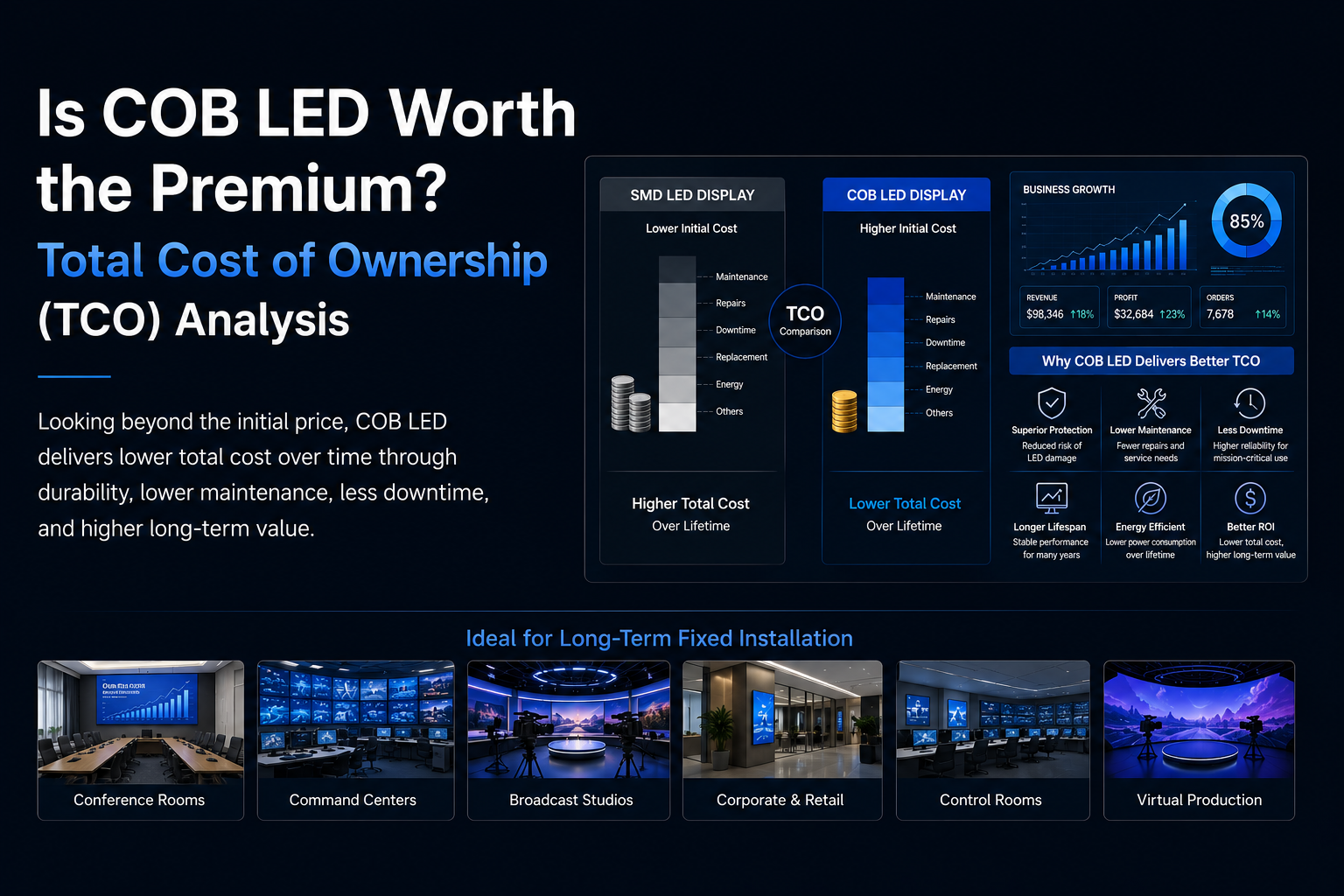
For example, if a large outdoor advertising screen is installed several meters above the ground, paying a premium for ultra-fine-pitch MIP or COB may provide little practical benefit.
On the other hand, a P0.7–P0.9 display in a boardroom or control room may justify a premium fine-pitch technology because viewers are much closer to the screen.
8. Which Technology Fits Your Project?
Choose MIP If You Need:
- Ultra-fine pixel pitch
- High pixel density
- Excellent image uniformity
- Premium indoor image quality
- Strong package-level reliability
- A balance between fine-pitch performance and serviceability
Recommended applications:
Control rooms, conference rooms, broadcast studios, XR, virtual production and premium indoor LED walls.
Choose COB If You Need:
- Ultra-fine pixel pitch
- Excellent surface protection
- High contrast
- Smooth visual appearance
- Strong durability
- Premium close-viewing performance
Recommended applications:
Command centers, control rooms, boardrooms, broadcast studios and high-end indoor LED displays.
COB is particularly attractive when visual quality and physical protection are more important than the lowest initial cost.
Choose GOB If You Need:
- Better protection than standard SMD
- Good impact resistance
- Moisture and dust protection
- A balance between cost and durability
- High-traffic or interactive installation
Recommended applications:
Retail, education, museums, rental displays, interactive LED walls and stage applications.
GOB can be considered a practical middle ground between conventional SMD and more integrated technologies.
Choose SMD If You Need:
- Cost efficiency
- Easy maintenance
- Mature technology
- A wide range of pixel pitches
- Large display areas
- Outdoor or general-purpose applications
Recommended applications:
Outdoor advertising, stadiums, rental screens, stage backgrounds, retail signage and large-format LED displays.
SMD remains the most practical choice when the project does not require ultra-fine pixel pitch or enhanced surface protection.
9. MIP vs COB vs GOB vs SMD: Quick Decision Guide
| Your Project Requirement | Recommended Technology |
| Ultra-fine pitch below P1.0 | MIP / COB |
| Premium conference room | MIP / COB |
| Command & control center | MIP / COB |
| Broadcast / virtual production | MIP / COB |
| High-touch environment | COB / GOB |
| Rental & staging | GOB / SMD |
| Outdoor advertising | SMD / GOB |
| Large display area with limited budget | SMD |
| Maximum surface protection | COB / GOB |
| Easy pixel-level maintenance | SMD / MIP |
| Premium image quality | MIP / COB |
| Best initial cost | SMD |
10. MIP vs COB vs GOB vs SMD: Which One Is the Winner?
There is no single winner.
The best LED packaging technology depends on the requirements of your project.
MIP is an excellent choice for premium fine-pitch LED displays where high pixel density, image quality and serviceability are important.
COB is ideal for high-end applications requiring excellent protection, fine pixel pitch, high contrast and a premium visual surface.
GOB provides a practical balance between protection, performance and cost, especially for high-contact environments.
SMD remains the most economical and flexible solution for general-purpose, large-format and outdoor LED displays.
The Bottom Line
MIP = Fine-Pitch Performance + High Image Quality
COB = Premium Visual Quality + High Protection
GOB = Protection + Cost Balance
SMD = Flexibility + Cost Efficiency
Instead of asking “Which LED technology is the best?”, the better question is:
“Which LED packaging technology best matches my pixel pitch, viewing distance, environment, maintenance strategy and project budget?”
That is the key to selecting the right LED display technology.
FAQ: MIP vs COB vs GOB vs SMD
Is MIP better than COB?
Not necessarily. MIP and COB use different packaging approaches. MIP can provide fine-pitch performance while retaining a surface-mounted package structure, whereas COB directly mounts LED chips onto the substrate. The better choice depends on the required pitch, maintenance strategy, visual performance and budget.
Is GOB better than SMD?
GOB provides additional surface protection compared with standard SMD, particularly against impact, dust and moisture. However, standard SMD can be more economical and easier to repair.
Is COB more expensive than SMD?
Generally, COB is positioned at a higher price level because of its manufacturing and packaging process, but actual project pricing depends heavily on pixel pitch, component selection, cabinet design and volume.
Is MIP suitable for fine-pitch LED displays?
Yes. MIP is specifically attractive for fine-pitch and Micro LED-based display applications. Commercial products are available below 1 mm pixel pitch, including P0.7 and P0.9 solutions.
Which is best for a conference room?
For premium conference rooms where viewers are close to the screen, MIP or COB are strong candidates. For projects where budget is more important, GOB or fine-pitch SMD can also be considered.