Introduction: Why Transparent Film LED Displays Are Redefining Glass in 2026
In 2026, the line between digital signage and architecture has almost disappeared. Brands no longer want to bolt bulky black cabinets onto their storefronts; they want motion, colour and video that appear to float on the glass itself. That shift has turned the transparent film LED display into one of the fastest-growing product categories in the display industry.
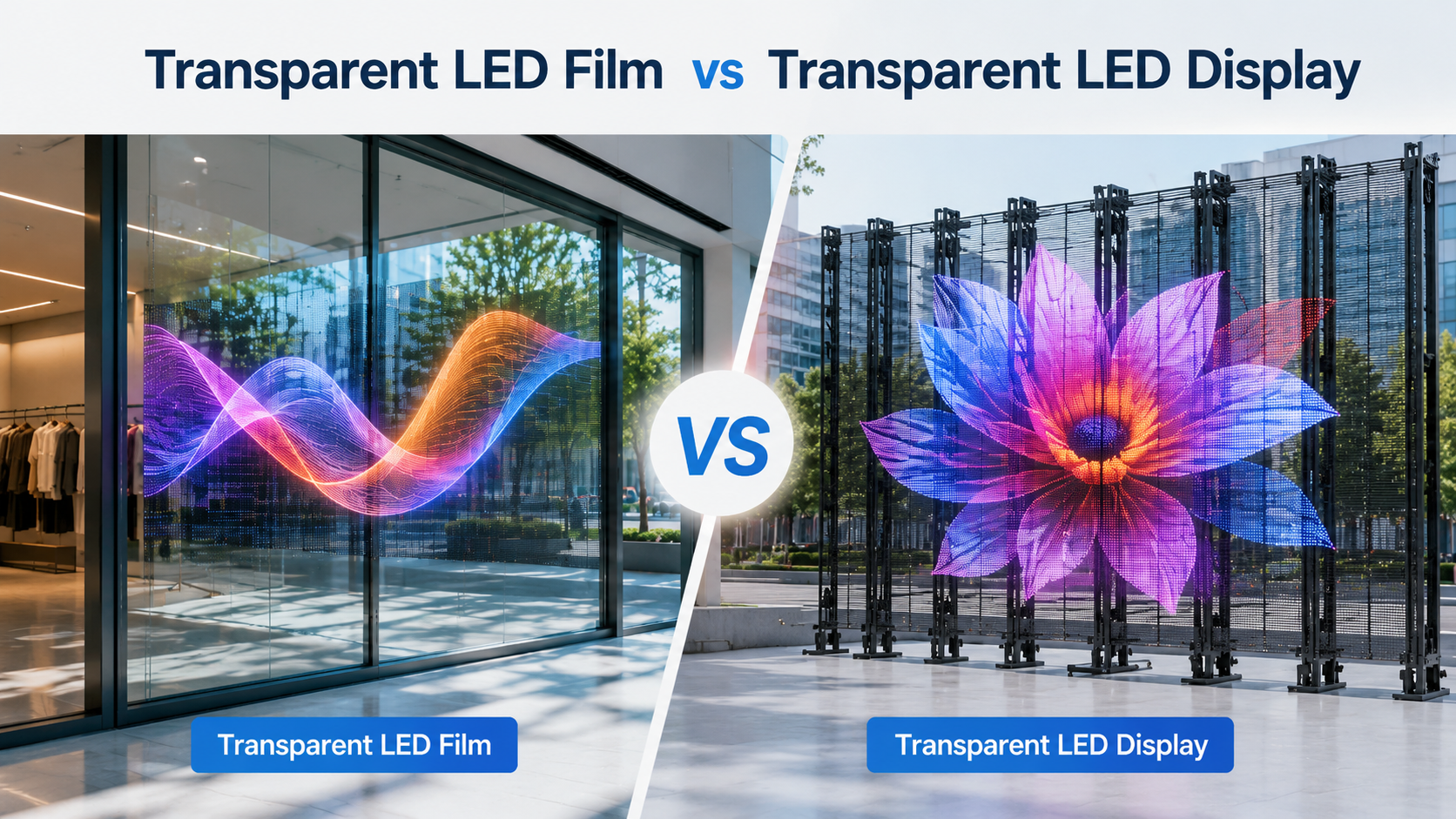
Unlike a conventional LED wall, a transparent film LED screen is a thin, adhesive-backed mesh of LEDs that laminates directly onto an existing glass surface — a shop window, an atrium partition or a curtain wall — turning it into a vivid media façade without blocking daylight or the view behind it.
For B2B buyers — retail chains, real-estate developers, system integrators and exhibition contractors — the appeal is straightforward: a glass window LED film display delivers high-impact digital storytelling at a fraction of the weight, power and structural cost of a traditional LED cabinet. This guide explains how the technology works, where it performs best, and how to choose the right flexible transparent LED film for your next project.
What Is a Transparent Film LED Display?
A transparent film LED display is an ultra-light, semi-transparent light-emitting-diode screen manufactured on a flexible transparent substrate rather than a rigid metal or plastic cabinet. Microscopic LED chips and fine conductive traces are embedded in — or bonded to — a clear film, producing a screen that is typically only 1–3 mm thick and weighs just 2–6 kg per square metre.
Because the film is fenestrated, the LEDs and traces occupy only a small percentage of the surface, so light passes freely through the gaps. High-end products reach 90% transparency, which means that in daylight the screen is nearly invisible from both inside and outside when it is switched off, yet it retains full-colour video when switched on. That see-through quality is the defining advantage of the led transparent film screen and the main reason it is specified for glass-heavy architecture such as retail frontages, banks, automotive showrooms and transport hubs.
Technical Advantages: Ultra-Thin and Flexible
Ultra-thin, ultra-light construction
The core engineering advantage of film-based transparent displays is their minimal physical footprint. At 1–3 mm thick and only a few kilograms per square metre, a transparent film LED display can be retrofitted to existing glazing without reinforced steel framing or heavy hoisting equipment. Installation teams routinely complete a storefront in a single night shift, and the reduced dead-load means architects can specify the product on structures that would never support a traditional LED wall.
Key technical characteristics to expect from a 2026-generation product:
- Thickness: 1–3 mm film; total assembly under 10 mm
- Weight: 2–6 kg/m² — roughly 10–20% of a conventional outdoor cabinet
- Transparency: up to 90% thanks to a high open-area mesh design
- Brightness: 1,000–5,500 cd/m², sufficient for daylight-facing glass
- Pixel pitch: commonly P3.91–P10 for film products
- Power: low average consumption from efficient drive ICs and content-dependent loading
- Viewing: dual-sided — visible to pedestrians and interior audiences alike
Flexibility and self-adhesive installation
The flexible transparent LED film bends, curves and conforms to non-planar surfaces, so it can wrap columns, follow curved façades or adapt to irregular mullion geometry — something that is impossible with rigid cabinets. The self-adhesive LED backing allows the screen to be laminated directly onto glass or acrylic, eliminating exposed frames, brackets and cabling that spoil the clean architectural line.
Flexibility also pays off in maintenance. Damaged modules can be peeled and replaced locally instead of requiring partial demolition of a façade, and the same roll-based logistics that make the film easy to ship also make it easy to reuse across temporary campaigns and seasonal windows.
Key Applications
Retail and brand experiences
Retail is the natural home of the glass window LED film display. Because the screen is transparent, a store can keep its merchandise, mannequins and daylight fully visible while overlaying dynamic video, pricing and promotions directly on the glass. On high-traffic shopping streets, a 90% transparency film catches attention with movement while preserving the visual openness that premium brands guard so fiercely.
Typical retail deployments include flagship storefronts, mall atrium media, in-window product launches and click-and-collect windows that switch from display mode to wayfinding. Because the film is thin and self-adhesive, brands can refresh the creative of a window in hours rather than days, and they can scale the same hardware across dozens of locations with a single content-management workflow.
Façades, architecture and public spaces
Beyond retail, the flexible transparent LED film is increasingly specified for building façades, curtain walls and interior architecture. Developers use it for media façades that animate at night yet disappear by day, for bank and corporate lobbies that need privacy screening with optional messaging, and for museums, airports and transit concourses where a lightweight, low-heat screen is preferred.
Event and exhibition contractors value the fast install-and-strike cycle, while automotive showrooms use transparent film to place video directly over the vehicles on display without hiding them. In each case the benefit is the same: digital media that adds a layer of storytelling to glass instead of replacing it.
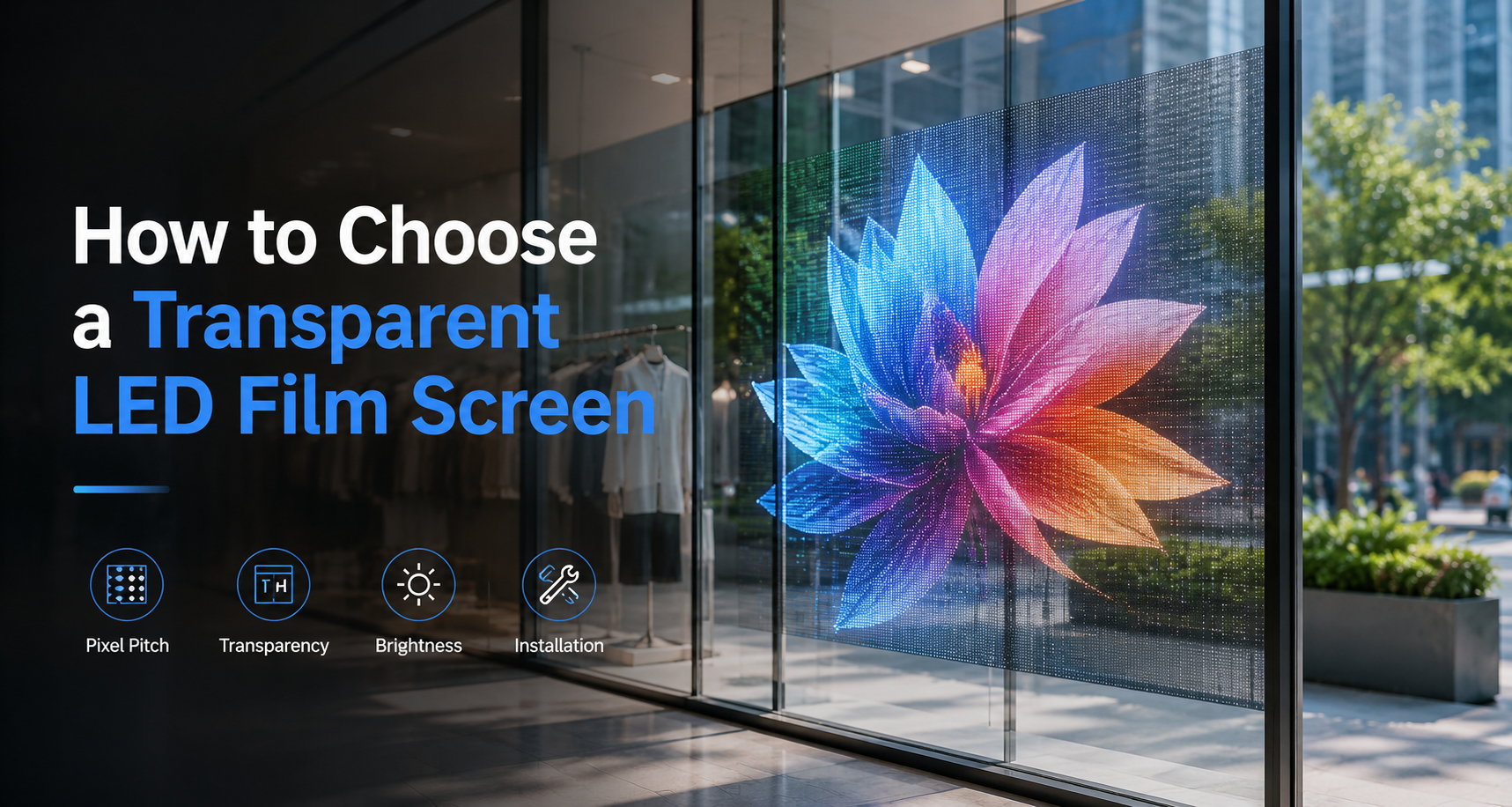
How to Choose a Transparent Film LED Display
Choosing the right led transparent film screen comes down to six decisions.
- Transparency vs. brightness. Higher transparency (80–90%) preserves the view but reduces pixel density and peak brightness. For daylight-facing street windows, prioritise brightness of 4,000–5,500 cd/m²; for interior or shaded glass, 1,500–2,500 cd/m² with higher transparency is usually the better balance.
- Pixel pitch and viewing distance. Match pitch to the closest realistic viewing distance. P3.91–P6 suits close pedestrian traffic and product detail, while P8–P10 is cost-effective for façades viewed from across a street or plaza.
- Adhesive and glass compatibility. A self-adhesive LED film must bond reliably to the specified glass. Confirm the adhesive type, the substrate (tempered, laminated or coated low-E glass) and the surface-preparation method, and check UV and heat-rejection coatings that can affect bonding and colour.
- Curvature and cut-outs. If your glazing is curved or irregular, confirm the minimum bend radius and whether panels can be cut to follow mullions and door frames.
- Thermal and structural factors. Verify the heat load on sealed insulated glazing and whether reinforcement is required. A quality transparent film LED display runs cool, but the glass assembly must still be assessed for thermal stress.
- Service, control and warranty. Ask how modules are replaced, what control system and content-management platform are provided, how the screen integrates with existing DVI/HDMI or media players, and what warranty covers LEDs, adhesive and driver electronics.
A practical procurement checklist is to request a live sample on real glass, a transparency and brightness test report, a reference installation at a comparable viewing distance, and a full bill of materials including spare modules and drivers.
Conclusion
The transparent film LED display has moved from novelty to mainstream specification in 2026. By combining 90% transparency, ultra-thin flexible construction and self-adhesive installation, it lets brands and architects add digital motion to glass without sacrificing daylight, sightlines or structural budget. For retailers chasing footfall, developers creating night-time media façades and integrators delivering fast, lightweight installs, the glass window LED film display is now one of the most versatile tools available.
The key to a successful project is honest specification: choose transparency and brightness for your actual lighting conditions, match pixel pitch to viewing distance, and partner with a manufacturer that supports adhesive, thermal and control questions end to end. Specified correctly, a flexible transparent LED film turns ordinary glass into a living, revenue-generating surface — and it does so while remaining almost invisible when you want it to be.