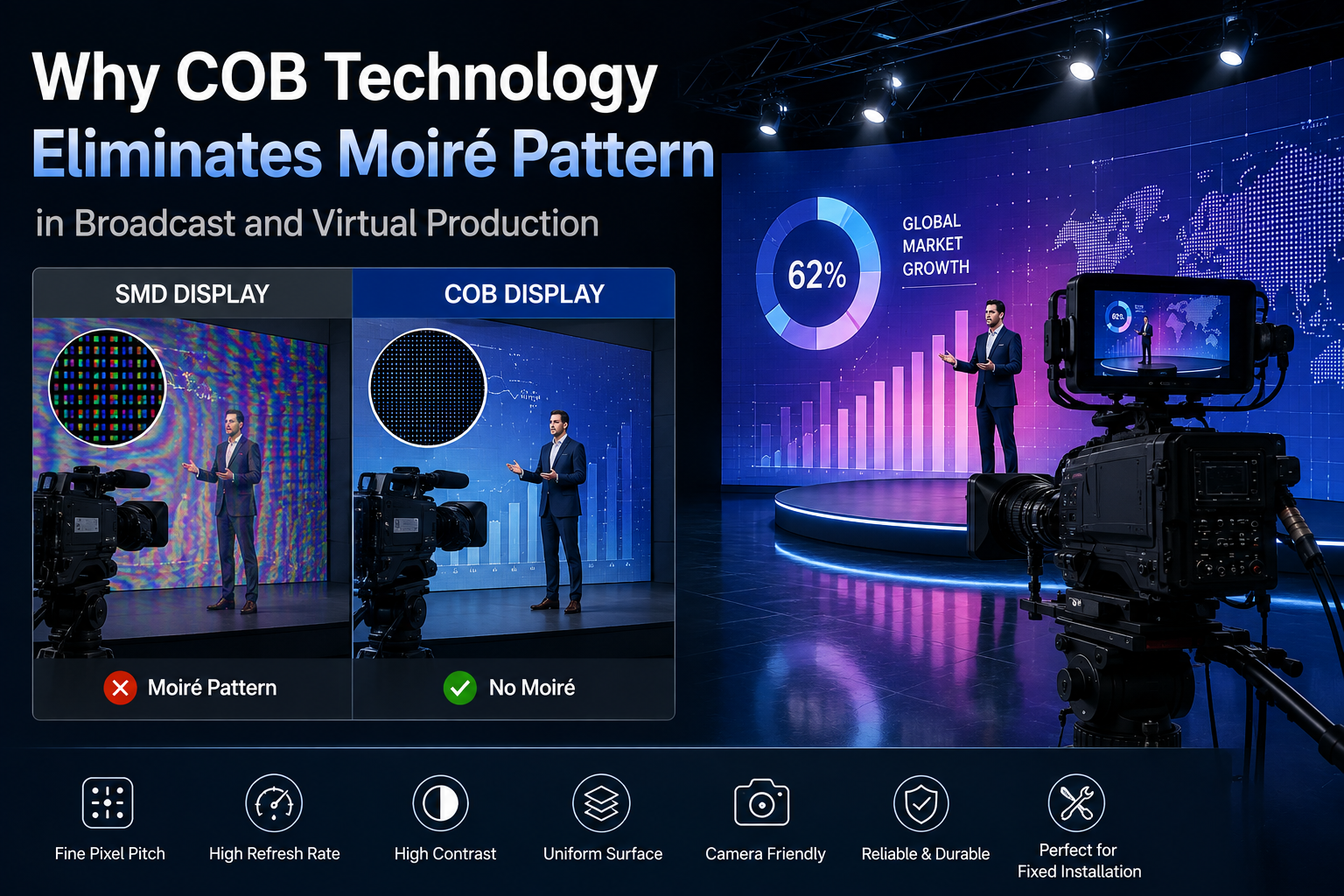
In modern broadcast studios, virtual production environments, and professional video walls, display quality is no longer measured only by brightness and resolution. Camera compatibility has become equally important.
One of the most common challenges when filming LED displays is the appearance of moiré patterns—unwanted waves, stripes, or interference patterns that can appear on camera. This can negatively affect live broadcasting, virtual production, XR stages, conference rooms, and other professional applications.
COB (Chip-on-Board) LED technology provides an effective solution by creating a more uniform and fine-pitch LED surface, helping reduce the visual conditions that cause moiré when the display is captured by professional cameras.
What Causes Moiré on LED Displays?
Moiré occurs when two regular patterns interact with each other.
In a camera environment, one pattern comes from the LED pixel structure, while the other comes from the camera's image sensor and scanning system. When these patterns interfere, the camera may capture visible lines, waves, or color distortions that are not obvious to the human eye.
The problem can become particularly noticeable with:
- Fine-pitch LED video walls
- Studio LED screens
- Virtual production LED walls
- XR stages
- Broadcast backgrounds
- Conference room displays
- Fixed installation LED displays
As cameras become higher resolution, the interaction between the camera sensor and LED pixel structure can become even more apparent.
Why COB LED Technology Helps Reduce Moiré
The key advantage of COB technology is its integrated LED packaging structure.
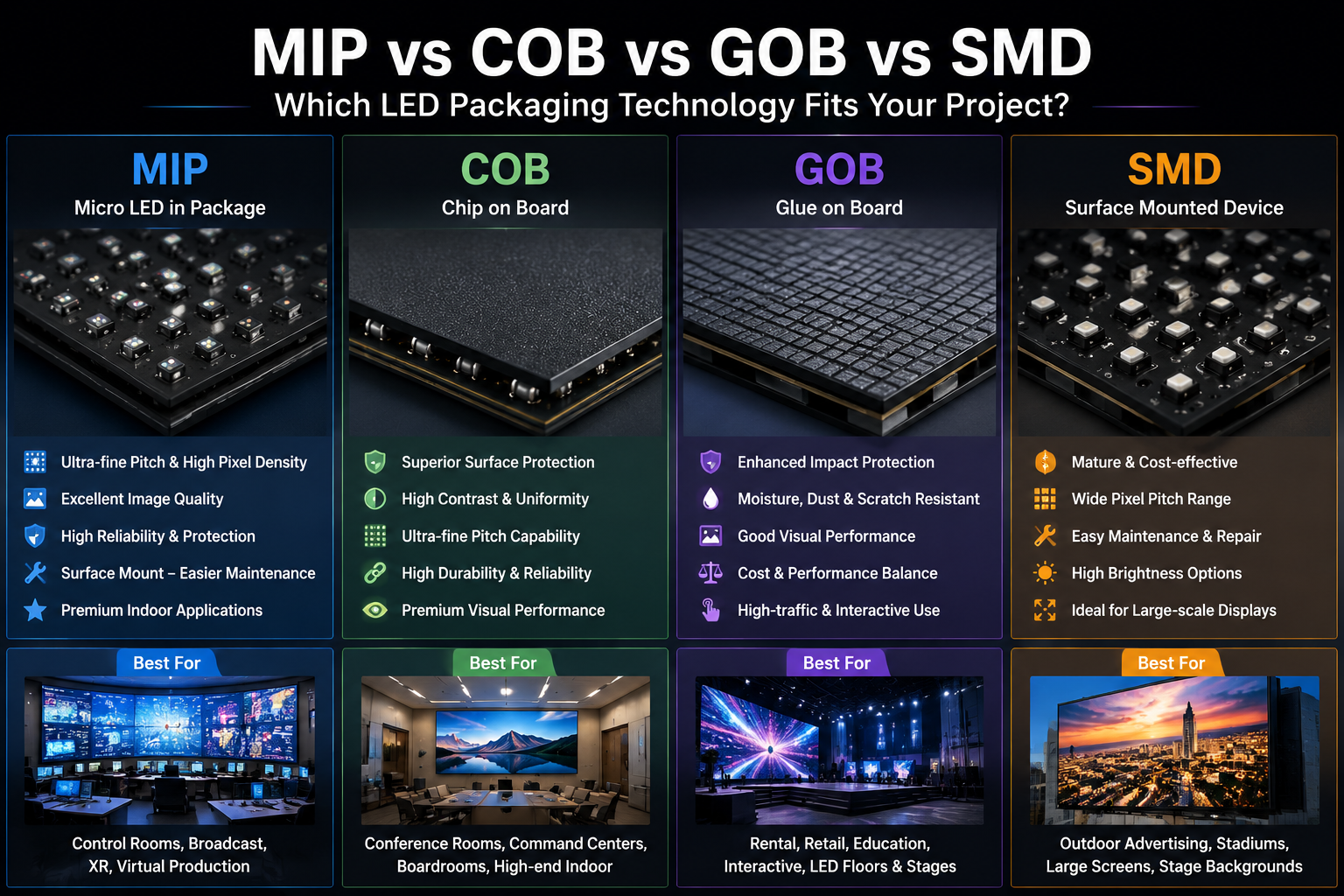
Unlike traditional SMD LED displays, where individual LED packages are mounted on the PCB, COB technology directly packages the LED chips onto the board and protects them with a common encapsulation layer.
This creates a more integrated and uniform display surface.
1. A More Uniform Pixel Surface
COB LED displays have a highly integrated surface structure. The reduced physical separation between LED chips helps create a more consistent pixel appearance.
For professional cameras, this can help reduce the visibility of individual LED structures and minimize unwanted interference patterns.
2. Smaller Pixel Pitch
COB technology is well suited to fine-pitch LED displays, such as P0.9, P1.2, P1.5 and other small-pixel-pitch solutions.
A smaller pixel pitch means that more pixels are packed into the same display area. From a camera's perspective, this creates a finer image structure and can help reduce visible pixel-grid effects.
For virtual production and broadcast applications, fine-pitch COB LED video walls can therefore provide a cleaner camera image.
3. Better Surface Flatness
COB packaging creates a relatively flat and integrated LED surface.
This is important for professional video production because uneven reflections and differences between individual LED packages can affect the appearance of the display when captured by cameras.
A flatter surface can contribute to more consistent image reproduction across the entire LED wall.
4. Excellent Black Level and Contrast
COB LED technology can also provide excellent black performance.
The black encapsulation and integrated package structure help reduce unwanted reflections between pixels, allowing the display to produce deeper blacks and stronger contrast.
This is particularly valuable for broadcast LED walls and virtual production LED screens, where dark scenes, cinematic content, and high-contrast imagery are frequently displayed.
COB vs. SMD for Camera Applications
Both SMD and COB LED technologies can be used for professional displays, but COB has several advantages when camera performance is a priority.
| Feature | COB LED Display | SMD LED Display |
|---|---|---|
| Pixel integration | High | Standard |
| Surface uniformity | Excellent | Good |
| Fine pixel pitch | Excellent | Good |
| Black level | Excellent | Good |
| Surface protection | High | Standard |
| Camera applications | Excellent | Good |
| Virtual production | Excellent | Good |
| Fixed installation | Excellent | Excellent |
For applications where the LED screen will be continuously filmed, COB LED technology offers an attractive combination of fine pixel pitch, high contrast, surface uniformity, and camera-friendly performance.
COB LED for Broadcast and Virtual Production
In broadcast studios and virtual production environments, the LED display is not simply a screen—it becomes part of the camera system.
The display must work together with:
- Professional cinema cameras
- High-speed cameras
- Virtual production systems
- XR/AR environments
- Camera tracking systems
- LED processors
- Studio lighting systems
A camera-friendly LED display should deliver consistent brightness, accurate colors, high refresh rates, and stable image reproduction.
COB LED displays are particularly suitable for these requirements because their integrated structure supports a fine and uniform pixel surface.
Why COB Is Also Ideal for Fixed Installation
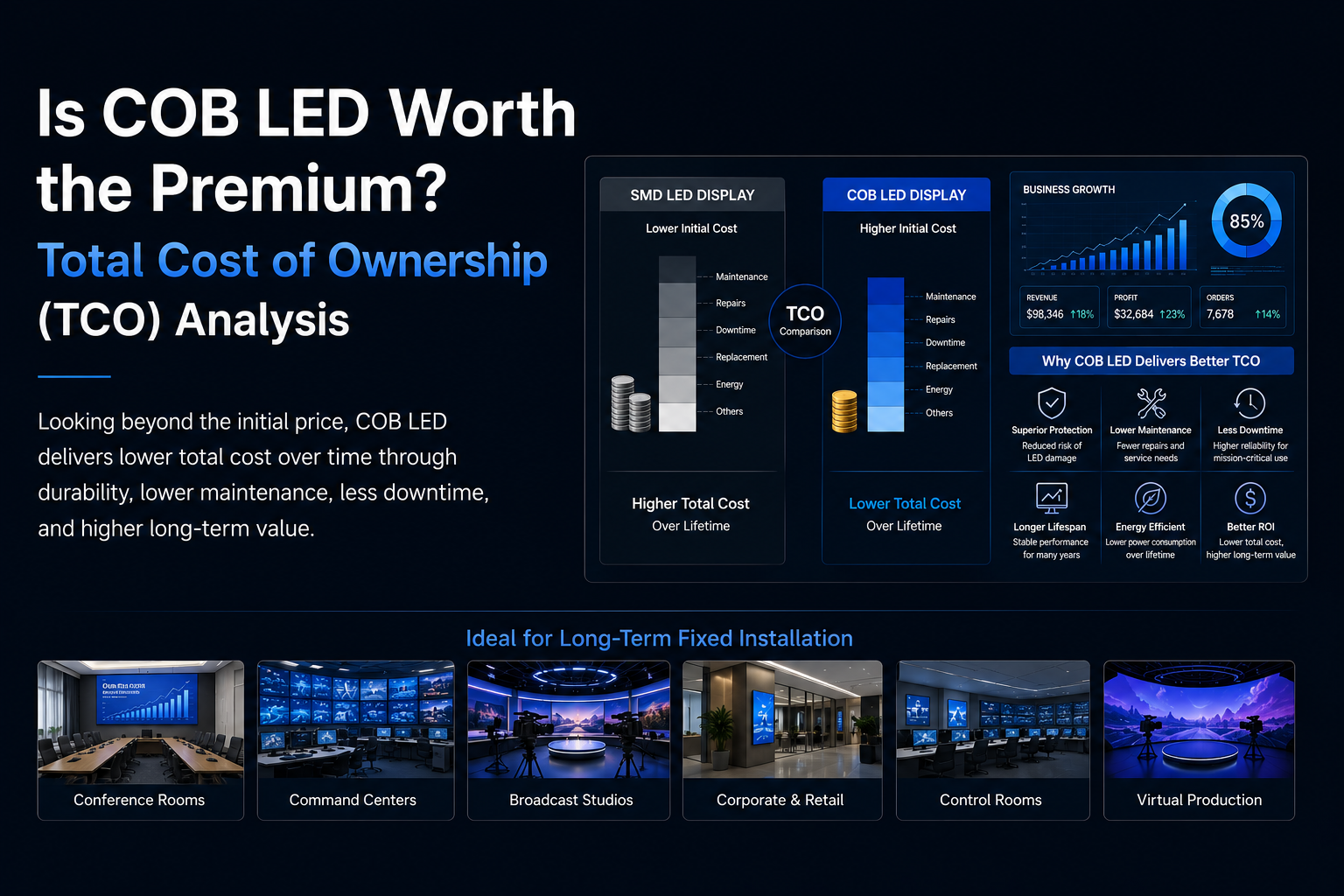
Although COB technology is highly suitable for broadcast and virtual production, its advantages also make it a strong solution for fixed installation LED displays.
For permanent installations, reliability and long-term image quality are critical.
Typical applications include:
- Fixed installation LED displays
- Indoor LED video walls
- Corporate meeting rooms
- Conference room LED displays
- Command centers
- Control rooms
- Broadcast studios
- Virtual production studios
- XR LED stages
- Premium digital signage
- High-end commercial displays
COB's integrated packaging provides strong physical protection for the LED chips, making it suitable for demanding long-term installation environments.
Key Factors for a Camera-Friendly COB LED Display
Choosing COB technology alone does not automatically eliminate every possible moiré effect. The final camera image also depends on several other factors.
Important specifications include:
Fine Pixel Pitch:
A smaller pixel pitch can provide a finer image structure for close-up camera shooting.
High Refresh Rate:
A high refresh rate helps reduce visible scanning and flicker when the display is filmed.
Low Scan Rate:
The LED driving architecture should be optimized for professional camera environments.
Stable Brightness:
Consistent brightness across the entire LED wall is essential for professional video production.
High Contrast:
High contrast helps maintain image depth and detail in dark scenes.
Accurate Color Calibration:
Precise calibration ensures consistent color reproduction across modules and cabinets.
Conclusion
For broadcast, virtual production, XR, and other camera-intensive environments, moiré is more than a visual inconvenience—it can directly affect the quality of the final video.
COB technology addresses the problem at the display structure level by providing a highly integrated LED surface, fine pixel pitch, excellent uniformity, strong contrast, and robust physical protection.
For professional applications requiring both camera-friendly performance and long-term reliability, a fine-pitch COB LED display can be an excellent choice.
Whether used as a broadcast LED video wall, virtual production LED screen, XR LED wall, conference room display, command center video wall, or fixed installation LED display, COB technology provides a strong foundation for high-quality visual performance.