Direct answer: A COB transparent LED screen is the newer of the two technologies, and the reason it is winning projects is not that it is brighter — it usually is not. It wins because chip-on-board packaging removes the lamp body from the light path, which lets the screen reach fine pixel pitch, survive being touched, hold its image at close range and still be seen through. A holographic transparent screen, built from exposed lamp strips, is the better tool when the screen is huge, the viewer is far away and the budget is the constraint. For retail windows, boardrooms, glass partitions and anywhere a person walks up to the glass, COB is now the default specification.
A category that quietly changed its default
For most of the last decade, "transparent LED screen" meant one thing: a grid of lamp strips in aluminium profiles, sold under names like holographic screen, invisible screen or crystal film screen. It worked, it was cheap per square metre, and it had an obvious flaw nobody could fix — get closer than a few metres and you stopped seeing an image and started seeing a grid.
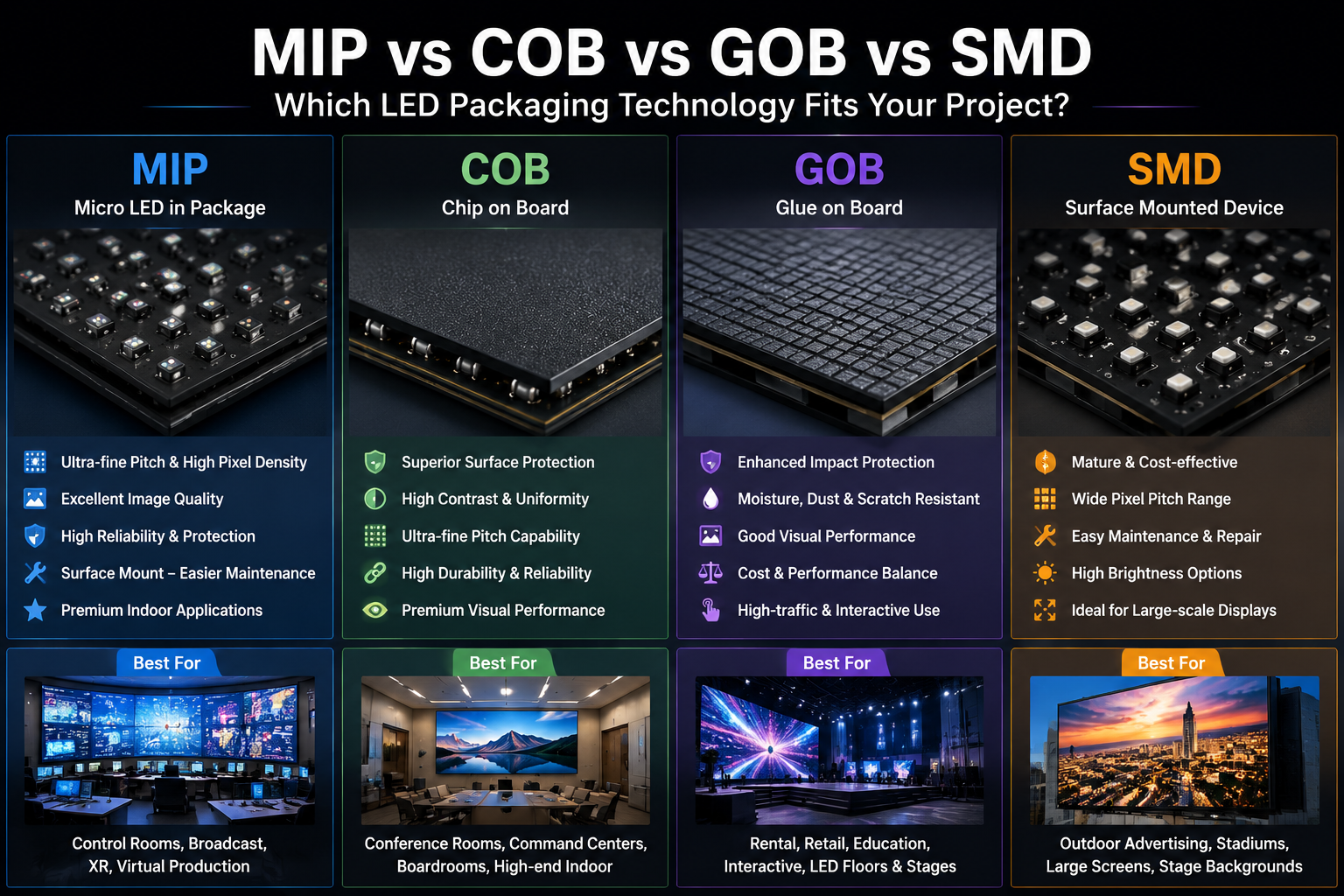
COB packaging had been solving that problem elsewhere for years. In fine-pitch indoor displays, bonding bare dies directly to the board and sealing the surface had already replaced lamp-based construction, because it delivered smaller pitch, better contrast and a surface that survives handling.
Applying that construction to a transparent substrate is what changed the category. The transparent version of COB keeps the perforated board for see-through, but replaces the lamp strips with a dense die matrix under a continuous optical seal. The grid disappears. The image stays.
That is the whole story behind the shift: not a new display principle, but a packaging technology arriving in a product category that had been structurally stuck.
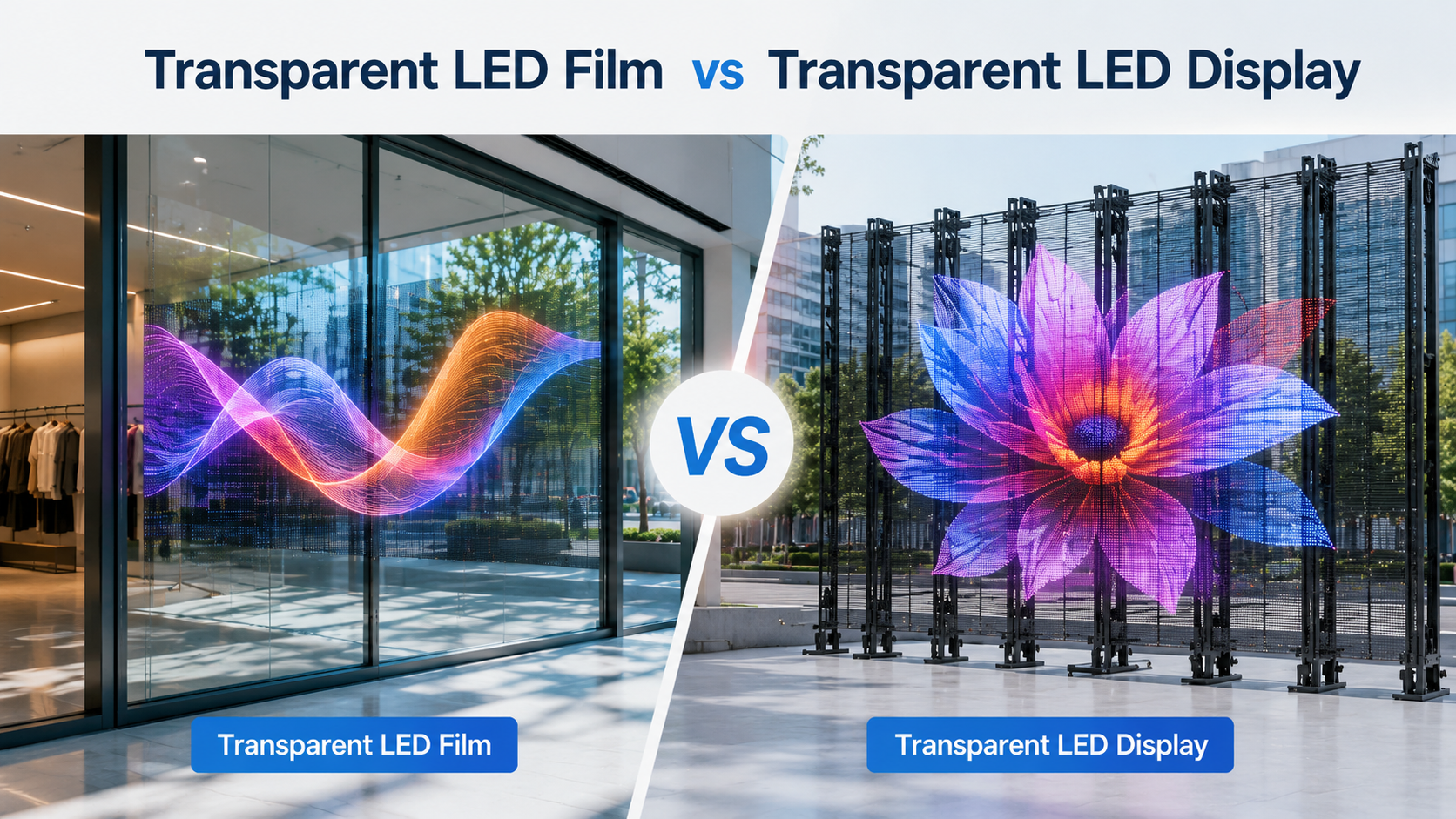
COB transparent LED screen vs holographic transparent screen: the advantages side by side
| Dimension | COB transparent LED screen | Holographic transparent screen (strip / grid) |
|---|---|---|
| Construction | Bare dies on hollow PCB, sealed under optical resin | Pre-packaged lamps on exposed aluminium strips |
| Surface | Continuous, sealed, nothing protrudes | Individual lamps protrude; gaps between strips |
| pas de pixel | Fine pitch — close viewing is viable | Set by lamp package and bar spacing; outdoor grille P16–P100 |
| At 2 metres | Clean image | Visible grid and pixel structure |
| Impact and moisture | Sealed surface resists contact and humidity | Exposed lamps and joints; needs protection |
| Viewing angle | Wide — 170° quoted on the GreenlandLED fine-pitch series | Narrower, with colour shift at the edges |
| Poids | Roughly 37.5% lighter than conventional integrated transparent screens (vendor figure) | Light per panel, but framing adds weight |
| Curved glass | Flexible PCB follows curves | Rigid profiles, flat or faceted only |
| Brightness in direct sun | Moderate; sealed surface limits drive | Higher; more thermal headroom |
| Service | Board or module level | Strip by strip — an advantage on huge arrays |
| Cost per m² | Plus haut | Inférieur |
| Best fit | Retail windows, boardrooms, partitions, showrooms, museum cases | Atriums, facades, stages, rental, large outdoor |
For the full specification path — open area, pitch, refresh rate, service method — see our COB transparent LED display guide.
The advantages of a COB transparent LED screen
- Fine pixel pitch. Lamp-free construction reaches pitches that strip designs physically cannot, so the screen works at 1.5–5 m instead of 5–30 m.
- A seamless image. No raised lamp bodies and no gaps between strips — the panel reads as one plane rather than a grid.
- Text you can actually read. Prices, menus, wayfinding and dashboards stay legible at close range, which strip construction cannot deliver.
- A sealed, touchable surface. The encapsulant bonds the dies into one continuous sheet, so the screen survives contact, cleaning and humidity.
- Wide viewing angle. 170° quoted on the GreenlandLED fine-pitch series, with ±2 nm bin-level colour control to stop hue shift at the edges.
- No visible pixel grain. Surface emission rather than point sources behind lenses removes the dot structure the eye catches at close range.
- Lower dead-pixel rate. With no solder joint or lamp package to fail, the manufacturer reports 90% fewer dead pixels than conventional integrated transparent screens.
- Lighter and thinner. Roughly 37.5% lighter than a conventional integrated transparent screen, which changes the fixing design and what a building lease will allow.
- Lower power, cooler running. 37.5% lower power draw and 30% lower surface temperature — which matters when the panel is mounted against glass with nowhere for heat to go.
- Curved and irregular glass. The hollow PCB is flexible, so the panel follows curves that rigid aluminium profiles cannot.
- Reduced glare. Index-matched matte encapsulation cuts specular reflection, so the image holds up in a bright window instead of washing out.
- Fewer camera artefacts. A continuous surface with no raised lamps and a finer, more regular pitch substantially reduces moiré in broadcast and virtual production.
Why more projects choose COB transparent screens
Five reasons, in the order they usually decide a project.
1. The viewer got closer
This is the single biggest driver, and it is a change in how spaces are designed rather than in the technology. Retail moved from "branding above the shelf" to "content at the shelf". Offices replaced solid partitions with glass and then wanted content on the glass. Showrooms put screens at arm's length from the product.
Every one of those decisions puts a person within two or three metres of the panel. At that distance a strip screen stops being a display. Once the requirement changed, the product had to change with it.
2. Text became part of the content
Transparent screens used to carry brand imagery and motion graphics — content that tolerates pixel structure. They now carry prices, menus, wayfinding, dashboards and product specifications. Text at close range exposes pixel grain, moiré and seam instantly.
A sealed, continuous surface with fine pitch is what makes legible type possible on glass. This is not a preference; it is a hard requirement of the content.
3. Glass is now specified as a surface, not a backdrop
When a screen sits on glass in a public space, it gets touched, cleaned, leaned on and exposed to humidity. Exposed lamps do not survive that duty cycle well, and a dead pixel on a transparent screen is conspicuous precisely because your eye passes through the panel and lands on the dark point.
Sealing the surface converts the screen from a fragile assembly into a cleanable one. That single change is often what makes a glass installation sign-off-able at all.
4. Fine pitch became affordable at the sizes that matter
The economics of COB have moved. It is still more expensive per square metre than strip construction, but the gap matters less at the sizes transparent screens actually occupy — a shop window, a meeting room wall, a lobby partition. On a 6 m² window, the difference between the two technologies is a line item, not a budget crisis. On a 300 m² facade it is decisive, which is why strip screens still own that segment.
5. The specification conversation got better
COB transparent LED screens are specified with figures that can be verified — panel open area, pitch, refresh rate, encapsulation, weight per square metre. Strip products are frequently sold on a single headline transparency number that, on inspection, measures the wrong thing.
Buyers who have been burned once by a transparency figure that did not mean what they assumed tend to specify the architecture that comes with more measurable attributes.
Where the holographic transparent screen still wins
Any honest comparison has to say this clearly, because it is the reason both products still sell.
Large format at distance. A 200 m² facade seen from a plaza does not benefit from fine pitch. The premium buys nothing the viewer can perceive, and strip construction is dramatically cheaper.
Direct sunlight. Exposed lamps with more thermal headroom go brighter. For a south-facing installation in summer, a strip or grille product is the correct engineering answer, not a compromise.
Rental fleets. A touring screen needs to be light, fast to rig and cheap to repair one strip at a time. Strip construction was designed for exactly that duty cycle.
Tight first-cost budgets. When the decision is genuinely cost-led and the viewing distance is long, strip wins on the numbers and there is no technical argument against it.
Who should switch, and who should not
Switch to COB if:
- The closest viewer is under about five metres
- The content includes text that must be readable
- The surface will be touched or cleaned
- The glass is curved, or the fixing has a weight limit
- You are specifying once and living with the result for years
Stay with a holographic strip screen if:
- The screen is large and viewed from across a room, plaza or atrium
- It faces direct sun
- It is a rental asset that gets rigged and struck repeatedly
- The budget is the binding constraint and the viewing distance is honest
The mistake in both directions is the same: specifying the newer technology where the older one does the job, or specifying the cheaper one where it will visibly fail. Neither is a quality argument. Both are fit arguments.
FAQ
Why choose a COB transparent screen over a holographic one?
Because the lamp body is gone. Fine pitch, a sealed touchable surface and a wide viewing angle all follow from one structural change, and those three properties are what close-range projects fail on with strip construction.
Is a COB transparent LED screen a new technology?
The packaging is not new — chip-on-board has been used in fine-pitch indoor displays for years. What is recent is applying it to a perforated transparent substrate. So the product is new to this category, but it is built on a mature process rather than an experimental one.
Is COB brighter than a holographic transparent screen?
Usually not. Strip constructions with exposed lamps generally reach higher peak brightness and have more thermal headroom for daylight. COB wins on close-range image quality, angle consistency, durability and weight.
Why does COB look better up close?
Because there is no lamp package in the light path. The die sits flat on the board under a continuous resin surface, so there is no raised body to cast a shadow and no package outline setting a minimum spacing. The result is finer pitch and a surface that reads as one plane rather than a grid.
Does a COB transparent LED screen block the view through glass?
Less than you would expect, but it does block some. See-through is governed by the PCB perforation rate — over 80% on the GreenlandLED fine-pitch series — not by the encapsulant transmittance figure of 95%, which describes the resin layer only.
Can it be installed on existing glass?
Yes, within limits set by the fixing method, the weight the glass or frame can carry, and where the driver boxes and cabling can be hidden. Get weight per square metre complete with frame before committing.
Is it worth the price premium?
On a shop window, boardroom wall or lobby partition where people stand close, yes — the premium buys a screen that works at that distance. On a large facade seen from far away, no: the premium buys nothing perceivable.
How do I compare two suppliers fairly?
Ask both for panel open area at a stated pixel pitch, whole-assembly transmittance including glass, brightness at a stated measurement condition, refresh rate, weight per square metre with frame, and the service method. A supplier who can answer all six is quoting a specification; one who cannot is quoting a brochure.
The short version
COB did not make transparent screens better across the board. It made them usable in a specific and rapidly growing set of situations — close viewing, text content, touchable surfaces, curved glass — that strip construction was never designed for. That is why the default has moved, and why the two products now sit side by side in a specification rather than one replacing the other.
If your project is one of those situations, the fastest way to settle it is a sample under your own lighting. GreenlandLED supplies fine-pitch COB transparent LED screens on four-layer hollow PCBs from its Shenzhen facility, with sample panels available for qualified projects.
Performance figures cited reflect the manufacturer's published data and are included to illustrate design targets, not as independently verified test results.